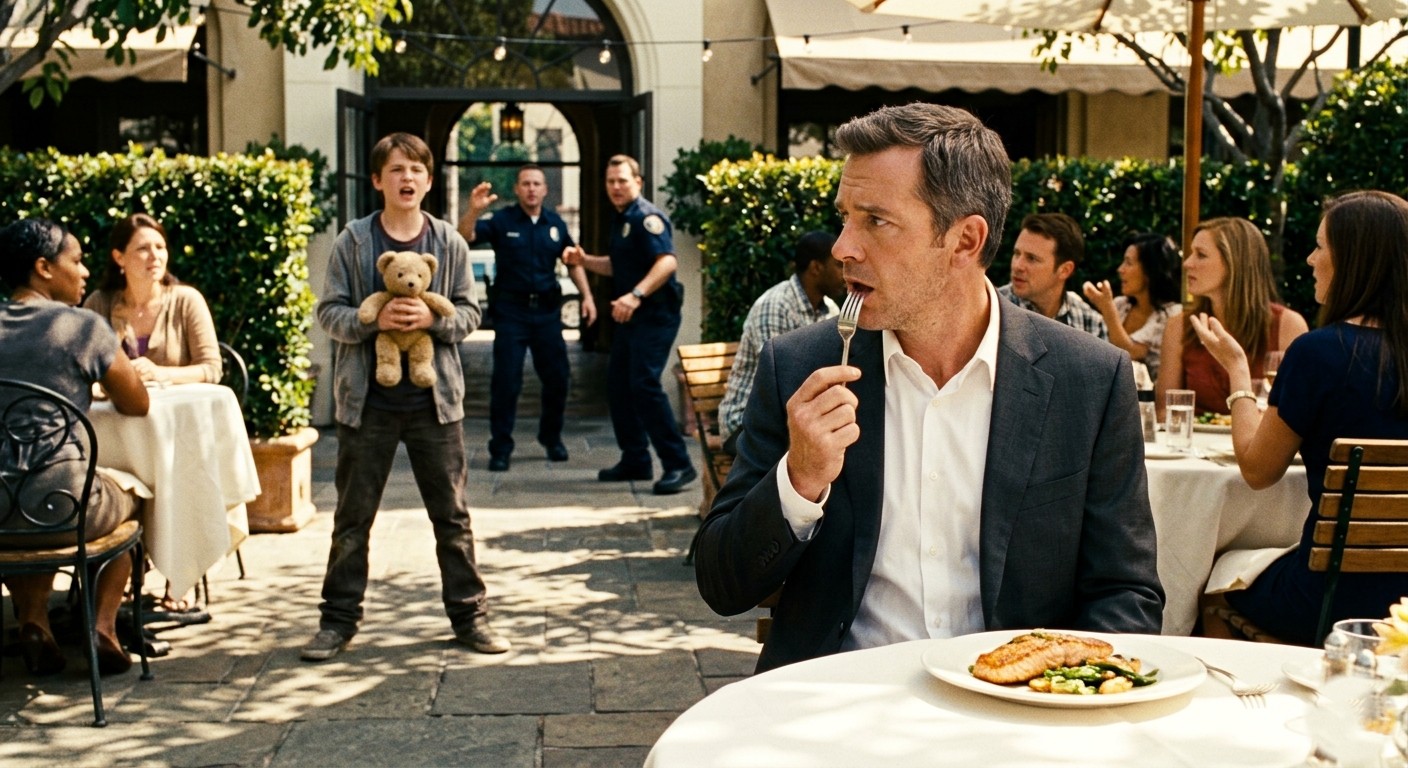
This is a story about a glass of water, a fish course, a phone call, a tapping sound on a restaurant window, and a marriage that had ended sixteen months before either of the people inside it had admitted that it had. Read it slowly. The twist is at the end.
Edmund Brooks was forty-six years old. He was the co-founder of a logistics company that had been valued, in its most recent funding round eight months earlier, at four hundred and twelve million dollars. He owned a house in the hills outside the city, a smaller apartment downtown that he used when he worked late, and a sailboat he had not been on in three years.
He had been married, for almost exactly a decade, to a woman named Caroline.
Caroline was forty-one. She had been an art consultant when they met. She had stopped working when they married, at his quiet encouragement, and had spent the ten years since running their home and chairing two small charities and being, in every photograph anyone had ever taken of them together, the kind of wife that men of Edmund's age and tax bracket are quietly assumed to deserve.
On a Tuesday morning in early April, at 11:47 AM, Caroline called him at the office and asked him, very lightly, where he was planning to have lunch.
He told her he had not decided. He told her he was thinking of skipping it. He told her, because she pressed gently, that if he did eat, he would probably walk down to the small café on Tremont Street — the one with the slate floor and the corner table by the window — because the partner he had been planning to meet had cancelled and he did not want to sit at his desk eating a sandwich while two assistants pretended not to watch.
Caroline said that sounded lovely. She said the spring salmon there was good. She said she might join him.
She did not join him.
The Boy
The boy's name was Theo Whitman. He was eight years old. He had been sleeping, with his mother, in a converted parking garage about four blocks from the café for the previous nine weeks. His mother was recovering, slowly and from a position of very little resources, from a bad case of pneumonia she had been unable to afford to treat until a free clinic on Beecham Street had taken her in.
Theo spent most of his days within a six-block radius of the parking garage. He had a small route. He visited the same back doors of the same three restaurants where the kitchen staff knew him and, on slower days, gave him things that were going to be thrown out anyway. He visited the café on Tremont because the woman who managed the back kitchen — a Hungarian grandmother named Erzsebet who had three grandchildren of her own and a soft spot for very polite small boys — sometimes had soup for him at the back door at the end of the lunch service.
On the Tuesday Theo became, for the next thirty seconds of Edmund Brooks's life, the most important person in the world, he had been crouched on the alley side of the café — out of sight of the dining room but with a clear view through a narrow window of the corner table by the front — for almost an hour.
He had been there because he had seen something at 12:18 PM that he did not understand.
What Theo Saw
Theo saw a woman.
She came in through the back kitchen entrance, not through the dining room. She was tall and well-dressed and she was holding what looked, even to an eight-year-old, like a name badge of some kind. She walked past Erzsebet — who was bent over a stockpot at the back of the kitchen and did not look up — and she went to a small stainless-steel station near the pass where two plates were sitting under heat lamps waiting to go out.
She took something very small out of a folded handkerchief in her pocket. She tipped it, carefully, over the plate on the left.
She straightened her coat. She left through the back the way she had come in.
The whole thing took eleven seconds.
Theo did not know who she was. Theo did not know what she had done. Theo only knew, with the particular sharp instinct of a child who has spent the last nine weeks watching adults very carefully to figure out which of them were safe, that what he had just seen was wrong.
He stayed in the alley. He pressed his face to the corner of the window. He watched the plates go out.
One of them was placed in front of a man at the corner table who looked, Theo thought, like he had not been sleeping very well.
The Tap on the Glass
Edmund had ordered the spring salmon.
The plate had been set in front of him at 12:34 PM. He had unfolded his napkin. He had said something quiet to the waiter about the wine. He had picked up his fork.
And then he had heard — very faintly, from somewhere behind his right shoulder — a small, fast, repeated tapping sound on the window glass.
He turned his head.
Standing on the other side of the window, about eighteen inches from his face, was a small boy with no shoes, a coat two sizes too big, and the most serious expression Edmund had ever seen on a child's face. The boy was tapping with one knuckle. The boy was mouthing two words, very clearly, over and over.
The words were: Don't eat.
Edmund set his fork down.
He looked at the plate.
He looked at the boy.
And in a moment that he would later describe to a federal investigator with the kind of flat precision that men use when they are trying not to let their voice break — in that moment, he understood that someone he had loved for a decade was, in some way that he did not yet have the words for, no longer someone he could understand.
The Manager
What Edmund did next is the part of the story that Theo's mother, Catherine Whitman, has retold to perhaps fifteen people over the year since it happened, and that she always tells the same way.
He did not eat. He did not call the police, not right away. He did not make a scene. He stood up, very calmly, and he walked outside, and he crouched down to the eye level of the boy who had tapped on the window, and he asked him, in a voice the waiter said he had not heard a man use in that café in twenty years of working there, what the boy had seen.
Theo told him.
Edmund listened without interrupting once. He asked the boy what the woman had looked like. Theo described her. The description matched, in every detail that an eight-year-old would have noticed, the woman Edmund had been married to for almost exactly a decade.
Edmund went back inside.
He asked the manager — a quiet man named Henrik who had been running the café for eleven years — to come to the corner table. He asked Henrik to call the police, very calmly, and to ask them to send someone in plain clothes. He asked Henrik to instruct the kitchen not to touch the plate. He asked Henrik, finally, if there was somewhere warm where the small boy outside could sit and have a hot drink and be looked after until his mother could be located.
Henrik did all of these things.
The plate of salmon — which was tested two days later at a state forensics lab — contained a dose of a colorless, tasteless industrial-grade compound that, in the quantity present, would have stopped a healthy adult human heart within forty-five to ninety minutes.
The Sixteen Months
The investigation that opened the following morning ran for three weeks before it was handed off to a federal task force, and it eventually produced a binder of evidence that Catherine Whitman has, with Edmund's permission, been allowed to read in part.
What the binder contained, in summary, was this.
For approximately sixteen months before that Tuesday, Caroline Brooks had been quietly moving money out of the joint accounts she shared with her husband. She had been using a structure of three small LLCs registered in two different states, each of which fed into a fourth entity registered in the British Virgin Islands. The pattern was careful. The amounts were modest enough, individually, to slip below the reporting thresholds that the bank's automated systems would have flagged. The cumulative total, by the morning of the lunch, was approximately eleven million dollars.
She had, in the same window of time, obtained — through a forger in another state whom the federal task force eventually identified and arrested — a second passport in the name of a Canadian citizen who did not exist.
She had purchased, two weeks before the lunch, a one-way ticket from a small private airfield ninety minutes north of the city to a destination in Belize.
The flight was scheduled for 4:15 PM the same day.
The forensics team determined that the compound on the salmon would have begun to take effect somewhere between 1:30 and 2:00 PM. She had not planned to be in the city when Edmund became unwell. She had planned to be, by 4:15 PM, halfway to a country with no extradition treaty.
She was arrested at the airfield, in the small private terminal, at 3:51 PM that afternoon, by two federal agents and a sheriff's deputy, with a roller bag containing the false passport, four hundred and twelve thousand dollars in cash, and a folder of paperwork relating to a beachfront property she had purchased the previous October.
She did not resist. She did not speak. She did not, until eleven hours later in a small interview room in the federal building downtown, say anything at all.
What She Said
I will not, here, repeat the things Caroline Brooks said in that interview room. They were, by the account of the agents who heard them, the words of a person whose understanding of her own life had been rearranged a long time before any of the people around her had noticed.
She spoke, for almost two hours, about a fear of being left.
She spoke about a marriage that had become, in her telling, a kind of slow disappearance — a thing that had been happening to her for years and that she had decided, somewhere in the middle of the second of those years, that she would not allow to end on someone else's terms.
She spoke about the eleven million dollars not as theft but as a thing she had been entitled to, a kind of pre-emptive severance, the money she would have been awarded in a divorce that she did not believe her husband would ever consent to give her.
And she spoke about the salmon, very briefly and very quietly, in a way the agents found harder to listen to than anything else she had said that night.
She was tried nine months later. She pleaded no contest to the federal fraud charges and was convicted, by a jury, of attempted murder. She is now serving a fifteen-year sentence in a federal correctional facility in another state. She has not, according to court records, ever requested a visit from her husband. He has not, according to the same records, ever requested to give one.
Theo and Catherine
I want to tell you what happened to the small boy who tapped on the window.
Theo Whitman spent the afternoon of the Tuesday in a heated office at the back of the café, drinking hot chocolate that Henrik made for him by hand, with a uniformed sheriff's deputy sitting six feet away in a chair turned in the polite direction of the door so as not to seem like a guard.
His mother — Catherine — was located at 5:47 PM, in the converted parking garage four blocks away, by a social worker the deputy had called. She arrived at the café at 6:11 PM, having walked the four blocks because she did not have bus fare, in a coat that was held together at the right shoulder with a safety pin.
Edmund Brooks was still there.
He had been there, by then, for approximately six hours. He had eaten nothing. He had spoken on the phone three times. He had cancelled, by text message, every meeting on his calendar for the rest of the week. He had not, anyone said, looked angry once. He had looked, mostly, like a man trying to figure out what to do with the rest of a Tuesday afternoon that had turned out to be the first day of a different life.
He met Catherine in the small private dining room at the back of the café.
I will not tell you what they said to each other, because Catherine has asked me not to. I will tell you that Catherine left the café that night with a folded piece of paper in her coat pocket on which Edmund had written down the address of a hotel two blocks away where she and Theo would be sleeping that night and the next, and the name of a person at his office who would, the following morning, handle the paperwork for the year of housing he had decided, in the six hours since he had stood up from the corner table, that he would be paying for.
What Happened After
It is now eleven months later. I do not have permission to share every detail. But this is what I can tell you.
Catherine Whitman is in remission from the lung condition that the pneumonia had aggravated. She is working part-time, as a bookkeeper, at the office of one of Edmund's small charities — a job she insisted on being given on the same terms as anyone else, with a salary at the market rate and no preferential treatment. She is, by every report, very good at it.
Theo Whitman is in third grade. He is attending a private school whose tuition is paid, anonymously, through a foundation Edmund established eight months ago for children who have lost stable housing before the age of ten. The foundation has, at last count, helped forty-one other children. Theo has not been told that Edmund pays his tuition. Catherine has been told. She has chosen, for reasons that are her own, not to mention it.
Theo has lunch with Edmund, at the café on Tremont Street, every other Sunday at one o'clock. They sit at the corner table by the window. Edmund orders the spring salmon. Theo orders a grilled cheese, which Erzsebet — who is still working the back kitchen — makes for him by hand and brings out herself.
Henrik, the manager, has stopped charging them.
Edmund has tried to insist. Henrik has refused. Henrik has told him, once, in a voice that did not invite argument, that the table belongs to them now.
The House Is Loud
I want to tell you one last thing.
Edmund Brooks sold the house in the hills six months ago. He bought a smaller house — still beautiful, still in a good neighborhood, but a house, not an estate — closer to the school Theo attends. The smaller house has four bedrooms instead of nine, a garden instead of a vineyard, and a kitchen that is built for cooking rather than for being photographed.
Catherine and Theo have their own apartment, three blocks away. They do not live with him. They have, at Catherine's careful insistence, their own life.
But on Sunday afternoons, after the salmon and the grilled cheese, all three of them go back to the smaller house and they cook dinner. Catherine usually brings something. Theo usually picks the music. Edmund, who has not, in twenty years of adult life, ever willingly cooked anything more complicated than toast, has been learning — under Catherine's quiet and patient correction — how to roast a chicken.
A woman who works in his office, who has known him for fourteen years, told me — and her exact words are the only words in this story I am going to quote directly — that when she dropped a file off at Edmund's house one Sunday evening last month, she had stopped on the front walk for almost a minute before ringing the bell, because she had not, in fourteen years of knowing him, ever once heard him laugh.
She said the house was loud.
She said she stood on the walk and listened to it for a while, and then she put the file inside the screen door and went home, because she did not want to be the thing that quieted it.