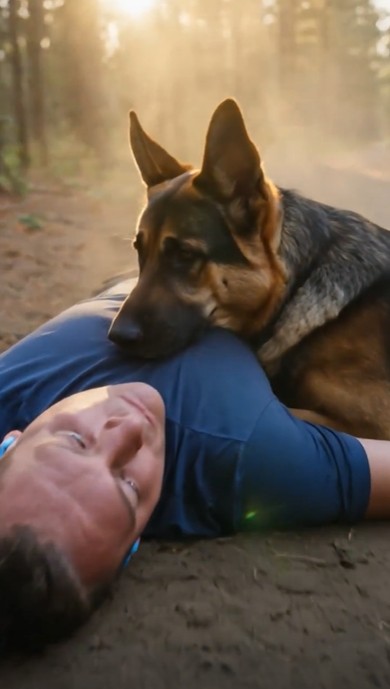
This story is real. The doorbell footage exists. The cardiologist who reviewed Wesley's chart said one sentence at the end that nobody who has heard it has been able to forget. Read it slowly.
Wesley Carmichael had played fetch with his German Shepherd every Saturday morning for four years.
Same backyard. Same yellow tennis ball — actually a small bucket of them, because Kaiser destroyed roughly one ball a month. Same routine: coffee at 9:30, ball at 10:00, biscuit for the dog at 10:30, shower, lunch with his wife Diane at noon. The schedule was so consistent that the neighbors three houses down said you could "set your watch by Wesley's throwing arm."
On the morning of April 18, 2026, the schedule held until 10:04 AM.
That was the moment the second throw left his hand.
That was the moment something inside his chest — something he had been quietly ignoring for the better part of six months — finally ran out of patience.
The Dog Was Named Kaiser
He was four years old. A working-line German Shepherd, sable coat, eighty-six pounds, with the long alert ears and the slightly anxious intelligence that the breed is famous for. Wesley had bought him from a breeder in Pennsylvania the year he retired from the post office.
Kaiser was not a trained service dog. He had no certifications. He had never been to a single class beyond basic obedience, which he completed in six weeks with a trainer named Maribel who later said Kaiser was "the kind of dog you don't need to teach — you just need to not get in his way."
He slept on the floor next to Wesley's side of the bed. He followed him from room to room. He had, in four years, never once been more than approximately thirty feet from his owner during daylight hours.
He was, by every account, exactly the kind of dog people imagine when they imagine a German Shepherd. Watchful. Loyal. Quietly obsessed with one human.
And on the morning of April 18, 2026, at 10:04:11 AM — according to the timestamp on the Carmichaels' Ring doorbell, which had a side-angle view of the backyard through the gate — that quiet obsession became the only thing keeping a 61-year-old man alive.
The Collapse
The footage is two minutes and forty-six seconds long. Diane Carmichael has watched it seventy-one times. She still cannot watch the first six seconds without putting her hand over her mouth.
At 10:04:09, Wesley winds up to throw. He is smiling. The angle of his shoulder is normal. Kaiser is already running in the direction of the previous throw, anticipating.
At 10:04:10, the ball leaves Wesley's hand. It arcs cleanly toward the back fence.
At 10:04:11, his right knee buckles.
What happens next is hard to describe in writing because it happens in a single second. His arm is still in the follow-through. His face changes — not in pain, but in a kind of distant surprise, the way a person looks when they hear a sound they cannot place. His left hand reaches up toward his own chest. He takes one wobbling half-step. And then, with absolutely no attempt to break his fall, he goes down.
He hits the grass on his right side. His head bounces once. The tennis ball bucket, which had been sitting beside him, tips over. Six yellow balls roll across the lawn.
He does not move.
The First Three Seconds
Kaiser was thirty-four feet away, mid-sprint, with his head down and his eyes locked on a ball that was still in the air.
According to the doorbell footage, he stopped running at 10:04:13.
He did not slow down. He did not glance back. He simply locked his front legs and skidded — the kind of full-body stop that working dogs do when a command interrupts a chase — and rotated his head a hundred and eighty degrees toward the place where his owner had been standing.
The ball he had been chasing landed in the bushes. Kaiser never looked at it again.
Dr. Lila Marsh, a veterinary behaviorist at Cornell who later reviewed the footage at Diane's request, said this was the part that did not surprise her. "Working-line German Shepherds are bonded to the point of pathology. He didn't have to see the fall. He felt the absence of the throwing motion. He felt his person stop being upright."
What happened next, however, is the part she said was unusual.
He Did Not Bark Immediately
Most dogs, when their owner collapses, bark. Sometimes for minutes. Sometimes until they are hoarse. The bark is panic — it is a request for someone else to come fix the thing the dog cannot fix.
Kaiser did not bark.
He ran the thirty-four feet in approximately three seconds and arrived at Wesley's body. The doorbell camera shows him sniffing the side of Wesley's face for exactly one second. Then he licked his cheek twice — fast, deliberate licks, the way a dog wakes another dog. Wesley did not respond.
Kaiser pawed at his shoulder. Then his ribs. Then, more firmly, he put one paw on Wesley's chest and pressed down — once, twice, three times — with the kind of pressure a dog uses when trying to make a sleeping owner move over in bed.
Wesley did not move.
It is at the 10:04:24 mark, exactly thirteen seconds after the collapse, that Kaiser does the first thing that nobody — not the cardiologist, not the behaviorist, not Diane, not the neighbors who later watched the footage at a barbecue and went silent — has been able to fully explain.
He stood up. He turned his entire body toward the house. And he ran.
What He Did at the Back Door
The back of the Carmichaels' house has a simple wooden door with a screen. Beside the door, hanging from a small iron hook, is a brass bell — a "dinner bell," roughly six inches across, with a leather cord pull. Diane had hung it there in 2019 because she liked the sound and because her mother had had one just like it.
Kaiser had heard that bell ring perhaps two hundred times in his life. Diane rang it to call Wesley in for dinner when he was working in the garden. Wesley rang it once, at Christmas, for the grandkids.
Kaiser had never, in four years, touched it.
At 10:04:31, the doorbell footage shows him arriving at the back door at full sprint. He scratches at the wood twice — hard, deep scratches that left marks Diane later refused to sand out. He barks three times, sharp and loud, directly at the door.
Nothing happens. There is nobody inside the house.
And then Kaiser does something the behaviorist at Cornell said she has only ever read about in case studies — never seen on video.
He turns his head, looks at the brass bell hanging two feet above him, and jumps for the leather cord.
The First Ring
He missed the first time. The footage shows him jumping, mouth open, and his teeth click shut on empty air an inch below the cord.
He landed, looked at the cord again, and jumped a second time.
This time he caught it.
The bell rang once — a single clean note that the doorbell microphone picked up clearly, loud enough that Diane, watching the footage later, said she could feel it in her chest.
Kaiser landed, looked at the door, waited two seconds, and jumped again. The bell rang a second time.
And a third.
And a fourth.
He rang the bell — by the doorbell camera's audio, which is timestamped — sixteen times in forty-one seconds. Sometimes he caught the cord with his mouth and tugged. Sometimes he jumped at it and batted it with his paw. Twice, he fell sideways and had to get back up.
He never stopped looking at the door.
The Neighbor Who Heard It
Carla Mendez lived next door. She was 39 years old, a labor-and-delivery nurse who had worked the overnight shift at the regional hospital and had come home at 7:30 AM to sleep. By 10:04 she had been asleep for approximately two and a half hours.
The bell, she told reporters later, did not wake her up at first. The Carmichaels' bell had rung for four years. Her brain had learned to ignore it.
What woke her up was the pattern.
"A dinner bell doesn't ring sixteen times," she said. "It rings once, maybe twice. After about the sixth or seventh ring, my brain just — switched on. I sat up in bed. I thought: something is wrong over there."
She pulled on a sweatshirt. She walked barefoot through her kitchen. She opened her own back door and looked across the low chain-link fence into the Carmichaels' yard.
She saw a tennis ball bucket tipped over. She saw six yellow balls scattered on the lawn. She saw a pair of brown work boots, soles up, behind the rose bush.
She did not see Wesley's face. She did not need to.
She vaulted the fence in a sweatshirt and bare feet. Her cell phone was in her hand. The 911 call she placed was timestamped at 10:05:47 AM — one minute and thirty-six seconds after Wesley hit the grass.
What the Cardiologist Said
Wesley was in ventricular fibrillation. His heart was not pumping. It was quivering — what cardiologists call a "shockable rhythm," because if you do not shock it back into rhythm with a defibrillator within a very specific window, the brain dies.
The clinical literature is brutally clear on this window. After four minutes without effective circulation, irreversible brain damage begins. After ten minutes, survival drops below 5 percent.
Carla Mendez began chest compressions at approximately 10:06:10. The paramedics arrived at 10:11:42 — five minutes and thirty-two seconds later — and shocked Wesley's heart back into a sinus rhythm on the second try.
The total time from collapse to first effective intervention was approximately 94 seconds.
Dr. Henry Okafor, the interventional cardiologist who placed two stents in Wesley's left anterior descending artery later that afternoon — the artery cardiologists call "the widowmaker" — was the one who pulled up the doorbell footage on his phone the next morning. He watched it twice. He sat down. He watched it a third time.
Then he walked into Wesley's hospital room, where Diane was sitting beside the bed, and he said the sentence that has been quoted in three newspapers and one cardiology newsletter since.
He said: "Mr. Carmichael, I have been doing this for twenty-two years. The truth is that your dog is the reason your wife is not planning a funeral right now. Every minute he saved you is a minute of your brain we did not lose."
The Part Nobody Has Explained
Diane Carmichael has been asked, by reporters and by friends and by one cardiology resident who came to the house specifically to interview her, the same question over and over.
How did Kaiser know to ring the bell?
Nobody had ever taught him. The bell was, in his entire life, a sound — not a tool. Dogs do not, as a rule, generalize from "humans pull this cord to make a sound that brings other humans" to "if I pull this cord, a sound will bring a human."
The Cornell behaviorist, Dr. Marsh, offered the only explanation that has stuck. "He had seen Diane ring it to bring Wesley in from the garden," she said. "He had seen, hundreds of times, that the bell produced a person. He did not need to understand the mechanism. He needed only to remember the pattern: bell rings, person comes."
"What's extraordinary," she added, "is not that he learned the association. It's that he reached for it in a crisis. Most dogs, in panic, return to instinct. Kaiser reached for a tool. That is — I'm choosing my words carefully — uncommon."
The Last Frame
The doorbell footage ends at 10:06:55, when the camera's motion-triggered recording window closes.
The last frame is not of Carla Mendez doing compressions. It is not of the paramedics arriving. The doorbell camera cannot see the part of the yard where Wesley was lying.
The last frame is of Kaiser. He is sitting in front of the back door, perfectly still. His ears are up. His head is turned toward the side gate — the direction from which Carla had come over the fence.
He is waiting.
The leather bell cord is still swaying slightly above him.
He has stopped ringing it. He has, in the language of working dogs, completed the task.
What Wesley Said When He Woke Up
Wesley Carmichael does not remember the morning of April 18, 2026. He remembers winding up to throw. He remembers nothing else until the recovery room.
The first thing he asked Diane, before he asked about his heart, before he asked what had happened, was three words.
He said: "Where is Kaiser?"
Diane told him. Kaiser was at home. He was on the kitchen floor. He had not eaten since the morning of the collapse. He had not let Carla, who had been checking on him, anywhere near him. He was, the neighbor said, "waiting at the back door, looking at the bell."
Wesley closed his eyes. Diane said he didn't cry. He just nodded, very slowly, and said one more sentence before falling back asleep on the hospital pillow.
"Tell him I'm coming home."
He went home four days later. Kaiser ate two full meals in the first hour. He has not, according to Diane, been more than ten feet from Wesley since.
The brass bell still hangs by the back door. It has two small tooth marks on the leather cord. Diane has not replaced it.
She said she never will.
If this story moved you, share it with someone who has a dog. Somewhere out there is an animal sleeping at the foot of a bed who would do the same thing — and a human who has no idea. They should know.